
The Next 700 PLSE Blog Posts
Post Metadata
The Next 700 Programming Languages was
published in 1966 by Peter Landin.
In it were ideas and methodologies around designing and formalizing programming languages that
persist to this day.
If you’ve ever used let or where in your favourite programming language,
or if you think about a language in terms of its core calculus,
or if you separate syntax from semantics,
you’ve been programming in one of Landin’s next 700 languages all along.
60 years later in 2026, it seems only fitting that I make a similar, if not greater, contribution to the scientific community. You hold in your hands “The Next 700 PLSE Blog Posts”: an exquisite compendium of PLSE blog posts from the past written by yours truly. You are welcome.
I’ve always wondered, (1) What kinds of PLSE blog posts are there? (2) What makes a good one? (3) Can we learn things from the ones already written? Or are those who look only to the past for inspiration doomed to flounder in this brave new world of cheap prose and fleeting attention spans? The answers to some of these questions lie in this blog post; the answer to (2) may surprise you1.
A History of the PLSE Blog
Luckily, the current iteration of the PLSE Blog is new enough that we have a primary source to tell us how it came about. Gilbert, a professor in the PLSE and Graphics groups, notes that the blog was “something [he] pushed for with two main goals”:
- Give students an opportunity to practice writing and communication skills.
- Increase the online presence and reputation of UW PLSE and our research.
The post Welcome to the PLSE Blog kicked off the blog in autumn 2023. 65 posts have been published since then, spanning the full breadth of our research areas from knitting and computer algebra, to software engineering, equality saturation, databases, and beyond. Nearly every graduate student in the group has published a blog post2, in addition to some faculty members, and even students from other departments. I think this shows that the blog has fulfilled its first goal of giving students opportunities to practice their writing and communication skills. Considering a blog post on Algebraic Semantics for Machine Knitting made it to the front page of Hacker News, I think the blog has made good on its second goal, as well.
But what came before all this?
Did group members in the past have a similar blog? This question led me on an extensive archeological investigation, which has unearthed evidence of an older PLSE Blog. Let’s go back to 2011, which included events such as:
- The Arab Spring.
- The 2011 Tōhoku earthquake and tsunami.
- Operation Neptune Spear.
- The Occupy Wall Street protests against wealth inequality and corruption.
- The public release of Minecraft.
- The box office debut of the cinematic masterpiece Cars 2.
- The 2011 UW CSE holiday party (photo here).
- The death of prominent North Korean cinephile and dictator Kim Jong Il.

Missing from the list of prominent events above, however, is the publication of the first known PLSE Blog post3, on Programming with Types by Pavel Panchekha on July 10, 2011.
In locating this post, I have also re-discovered an index of the so-called “old” PLSE blog, which offers a window into our forebearers and what they blogged about. The primitive technologies of their time (e.g., netbooks, Google+) and the lack of force-multiplying productivity technologies (e.g., Slack, Workday) did not stop the “old” PLSE blog authors from publishing across a diversity of topics.
If you’ve ever wondered about where the PLSE “pulse” logo comes from,
you can find out from a blog post documenting its design from 2016.
Can’t remember the difference between “runtime”, “run-time”, and “run time”?
Worry not,
“run” + “time” = ??? explains it all.
Hoping to expand the capabilities of your Emacs installation?
There are no
less
than 3 posts
elucidating how you can finally do your real work once you’re done tweaking your .el files.
Perhaps you’ll find advice about navigating NSF grants
useful if you’re applying for the GRFP,
or maybe you’ll think twice before abandoning your research code
because someone might use it one day.
The old PLSE blog goes quiet after 63 posts between 2011 and 2017;
the last post explains How CSS Floats Work
and was published on March 12, 2017.
The fate of the authors is as clear as the sailors of the Mary Celeste.
A Taxonomy of PLSE Blogs
What do people write about in their blog posts? It turns out that the topics seen in the PLSE Blog are as varied as the eclectic members of the group. At the time of writing, there are no less than 80 unique tags that classify blog posts.
They range from research-focused, denoting blogs about the Rocq theorem prover, computer algebra systems, quantum computing, and computational fabrication. Others talk about our outreach efforts, and doing undergraduate research in PLSE. Not everything is serious, though. There’s a fair amount of blog posts that aren’t related to research at all. Oliver wrote about video games, there’s a blog post about giving the best PoCSci talk ever by acclaimed PoCSci supreme leader Amy Zhu, who, at the end of PoCSci 2026 and AY 2026, ascended to a higher plane of existence (RIP).
And, of course, who could forget the series of blog posts that started with an important historical record of particularly hard times in the Allen School before devolving into a pointless argument in which a poor, lost soul argued for the superiority of an objectively outdated and nonsensical measurement system, culminating in a deeper discussion about the virtues of consistency.
I digress. The point of this section is to describe a basic taxonomy of PLSE blog posts to date. Here’s my best-effort attempt at doing so:
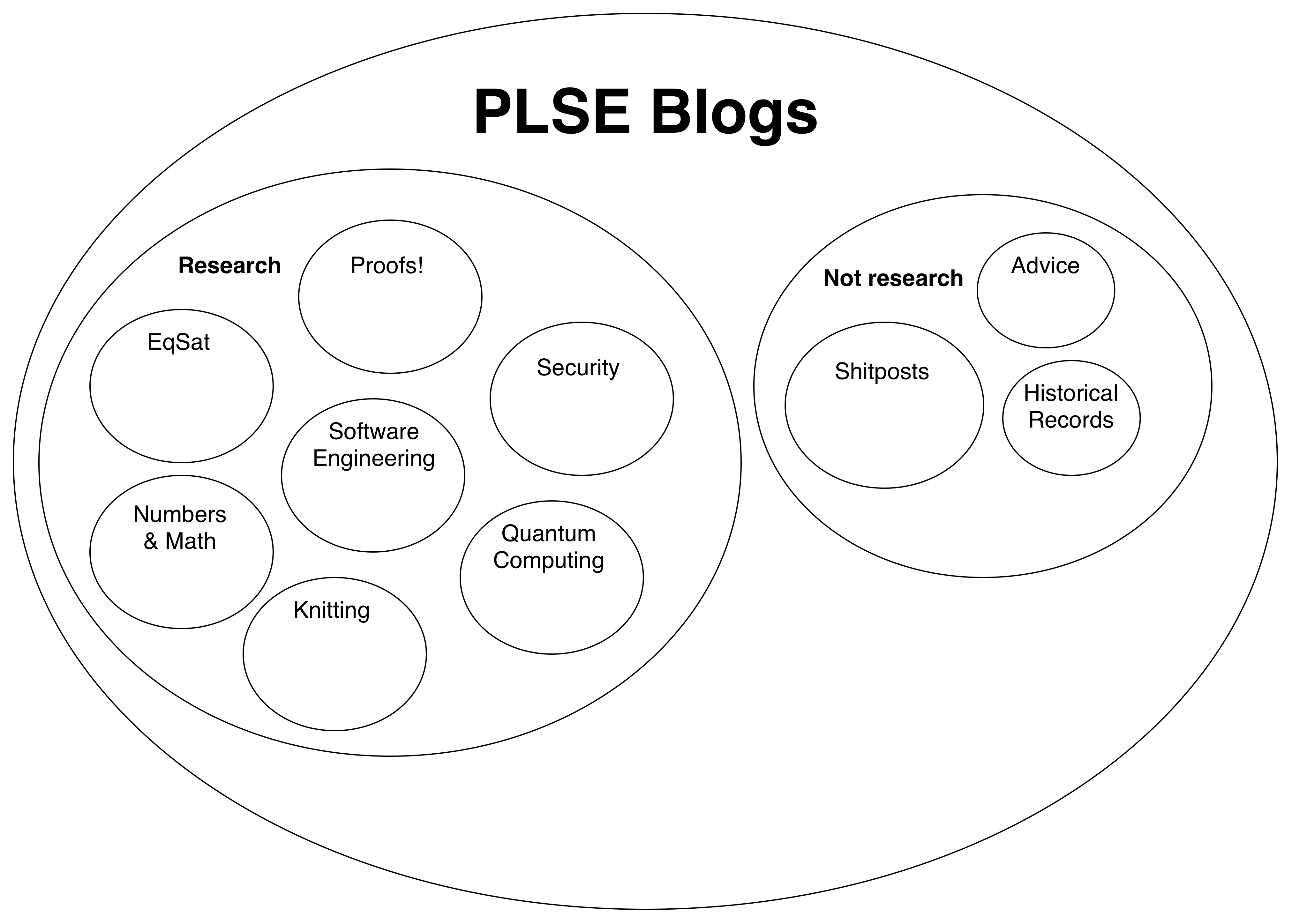
The universe of PLSE blogs can be split into two top-level taxa: “Research” and “Not research”, which comprise more specific categories into which all blog posts can be organized. Finally, with this taxonomy, we can begin to formalize a method by which you can decide what type of blog post to write.
How to Write a PLSE Blog Post
Congratulations! You have been chosen (or volunteered) to make a contribution to the fount of knowledge that is the PLSE Blog. But, what do you write about? Perhaps you have some research that you want to publicize, or you’ve discovered some cool new workflow you want to share with the world. Maybe you’ve been playing a video game that you think the rest of the world should know about. The decision fatigue can be immense with the endless possibilities. Worry not, because I’ve come up with a failsafe way to help guide you in choosing a topic with the patented PLSE Blog Decision Diagram™, which I include below, free of charge:
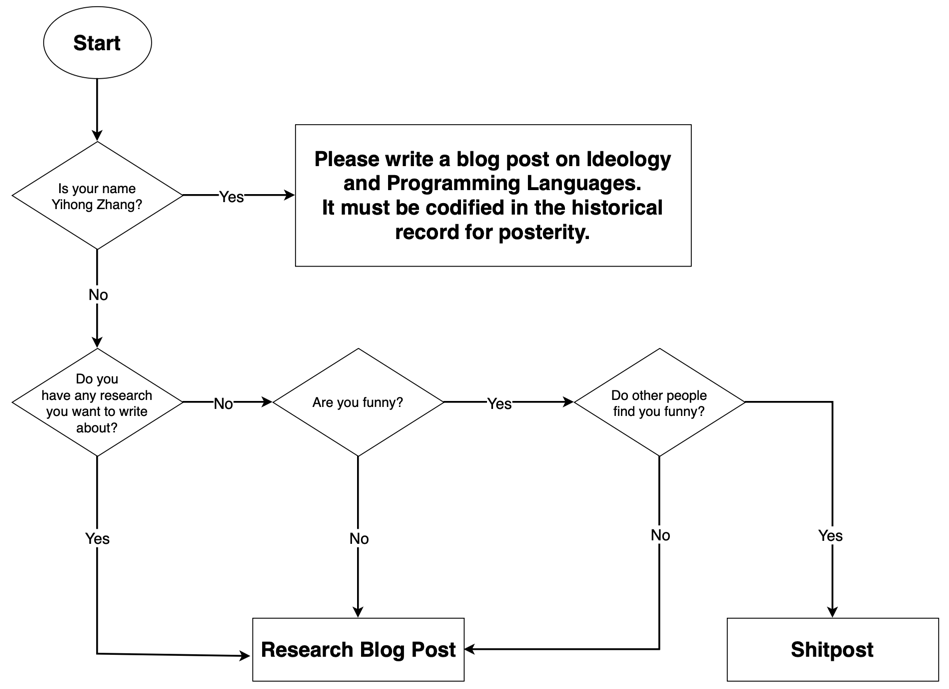
I hope the PLSE BDD will aid in helping you decide what to write about, or at least reduces decision fatigue because we could all use less of that in our lives. Remember, the choice of what to write about ultimately rests with you—the author. You should be excited about whatever it is you choose to write about. From personal experience, it is a slog writing about something you care very little about, while words practically fly from your fingertips to your editor when you’re writing about something you care about.
For students (or those with access to the source code of the PLSE website repo),
the “Blog” section in the README has formatting guidelines
and helpful commands you can run to preview your post-in-progress.
The Future of PLSE Blog Posts
In this work, I developed a basic taxonomy that can categorize most existing PLSE blog posts. I introduced the PLSE Blog Decision Diagram™, which significantly simplifies decision procedures pertaining to the choice of the type of blog post that one might write. In exploring related work, I uncovered the existence of the “old” PLSE blog, which captures the wisdom of the ancients that came before us. Looking at the past often raises questions about the future. Where were we before? Where are we heading now?
Is the written blog medium dead? Do people still read?
Perhaps the future lies in the expansion of the PLSE Blog into different media. A PLSE TikTok? Day-in-the-life videos of PLSE group members? Reaction videos to papers? A podcast? A subscription model for PLSE blog posts?
I don’t have the answer, nor am I adequately plugged into the cultural zeitgeist to attempt to expand a blog post into a reel or a TikTok. Time moves fast, trends come and go even faster; what’s popular now might be totally irrelevant next week—the future is uncertain.
What I do know for certain, however, is that approximately every two weeks excluding holidays, a PLSE Blog post will be published: a tradition that will continue until the end of time.
Acknowledgments
I must thank Nat Hurtig for his thoughtful comments on a draft of this blog post, his tireless service as the PLSE blog chair, and for reminding me of the proper use of semicolons; Thanks to Gilbert Bernstein for starting up the PLSE blog.
-
Or not, I really can’t predict how a random person on the internet responds to a blog post. ↩
-
A record of those who have not is being compiled by our benevolent PLSE blog overlord; resistance is futile. ↩
-
It is entirely possible that even older PLSE Blog posts may exist, possibly dating back to when PLSE was WASP. Additional research is required. ↩