
Twelve Stratagems for PoCSci
Post Metadata
PoCSci (pronounced “poxy”, etymologically derived from “Potentially Computer Science”), is a long-running computer science conference traditionally hosted by the Paul G. Allen School of Computer Science and Engineering. The venue is notable for its forward-thinking, experimental, and sometimes radical approaches to computer science. Chief among the most disruptive of the tenets held by PoCSci-goers was that every talk’s goal must be laughter, for what better gauge of absurdity and creativity could there be? At its nascence, a faction of opposing scholars stood in their austere fortresses and endured days of talks that won not a single smile; PoCSci came together each year to advance the front of laughter and make its peals echo within those bleak stone citadels.
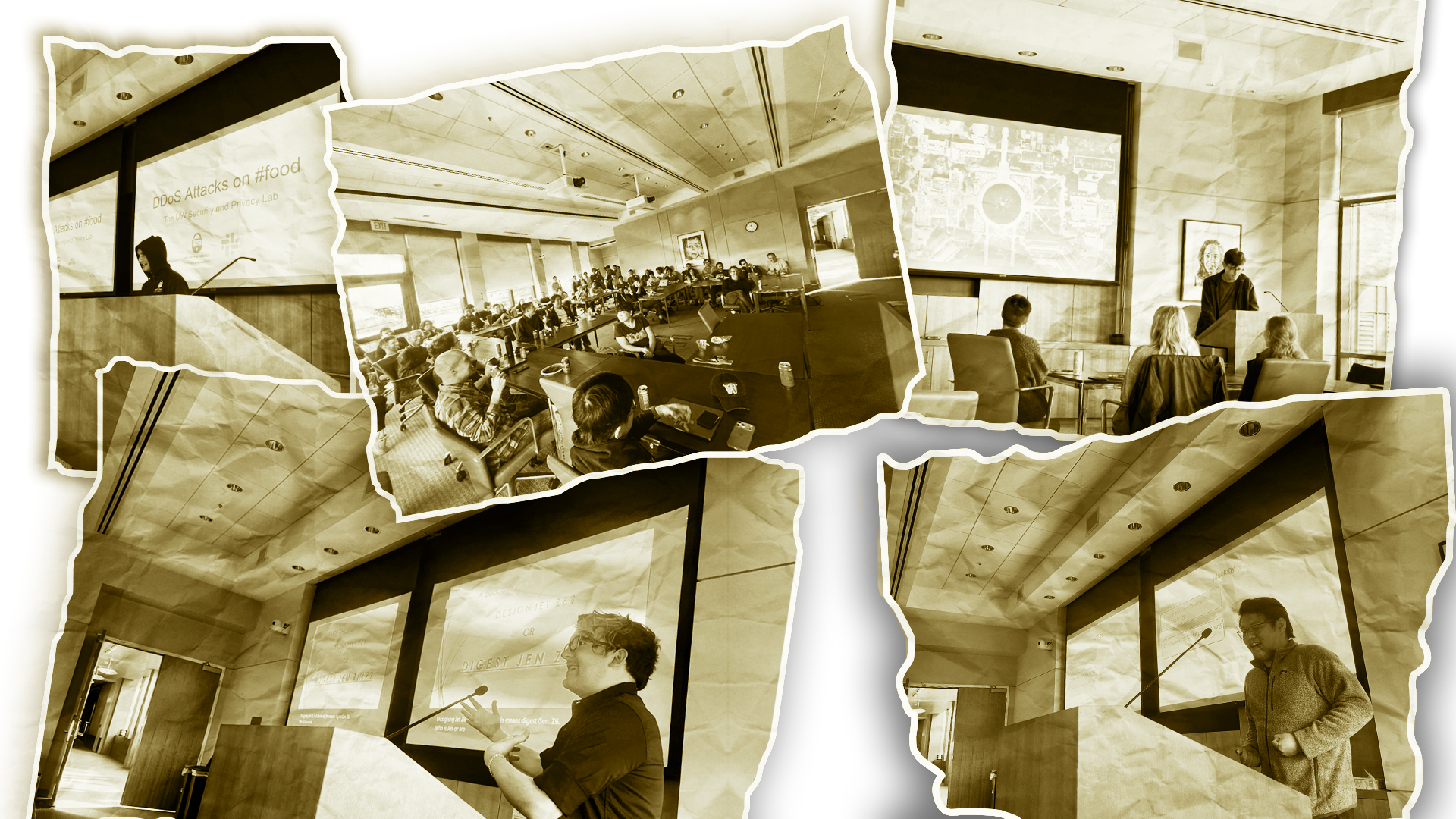 Caption: Uncovered photos of past PoCSci gatherings that would have been from the same era as the below document. Dedicated efforts in cataloging researchers in the field at this time has led to the widely-held working theory that the speakers are, clockwise from top left, Gregor Haas, Nick Walker, Yihong Zhang, and Jesse Martinez.
Historians believe this document was written by Amy Zhu, a former PoCSci commander and strategist who was in charge of the PoCSci revival campaign the half decade following a historic retreat in the years 2020-2021 C.E. We know from contemporary accounts that one of her main tenets of a successful revival effort was research into and documentation of the history of PoCSci, especially the keeping of accurate longitudinal records. (N.B. Unlike SIGBOVIK, proceedings of PoCSci are not typically published, and durable records did not previously exist). Frustrated at the lack of availability of historical information and of past teachings, she ordered the assembly of this document. Evidence suggests that much of the spadework behind this treatise was initiated by her predecessor, Max Willsey, and completed to pass down to her successor, Andrew Alex, before she ascended.
The following sketch, reproduced here as an artist’s rendition, appeared on the front and back endpapers.

Part 1. Stratagems for Successfully Giving a PoCSci Talk
1. Build no scaffolding where you build no buildings
Even though the full picture of your work may involve lengthy details or setup, which you might have spent a long time on, not all of it deserves to be in the short five minutes of the talk. Focus on developing punchlines and making sure that every piece of information serves as setup or payoff.
2. Pour new wine into the existing gourd
Classic formats lead to good talks without much resistance. For example, setting up a problem and proposing a solution, where one of the two is computer science-related (ILP Scheduling for Sumo Tournaments, DDOS Attacks on #food, OneSnackAway: The Next Generation in Mobile Snack Apps). Or, take a classic paper format (X Considered Harmful) and adapt it for an absurd or silly domain.
3. Trade the robe for the motley
Not every talk needs to be a conference-format talk where your persona is a computer science researcher. If your content is not suited for the traditional conference talk format, such as a collection of observations, adopt a new persona and prepare to give a performance that will enhance the content. (For example, a talk about the difficulties of poster printing being presented as a true crime podcaster explaining the mystery of the printer room.)
4. Harvest native plants to furnish the storehouse
The audience already has a rich, pre-seeded base of specific, shared, topical knowledge that you can use to poke fun. Computer science-related jokes and Allen School-specific jokes are something everyone will understand, and people will laugh because it’s an experience that this relatively small group of people have.
5. Wait at leisure while the audience labours
Relish the moment when you get laughs. Wait for the right moment when most of it has died down to begin talking again or the audience may not hear the next setup.
6. Throw the shuttle 99 times to perfect the 100th
If you repeat the same action many times, you will naturally tend towards the most ergonomic and “energy conserving” version of the action. Similarly, if you practice giving the talk a few times, you will tighten the material and refine your movements so you will be confident instead of awkward.
Part 2. Stratagems for Successfully Organizing PoCSci
1. Remind the heavens of their decrees
Throughout the year, people will come up with a silly idea and offhandedly say that they should use that idea for PoCSci, but they will inevitably forget what their idea is by the time PoCSci happens. Make a note in case you have to remind them later.
2. Keep the mouth charged while the body sleeps
Never miss an opportunity to advertise or tell people about PoCSci if it’s relevant, even if PoCSci is far in the future. Ingrain the idea of PoCSci in people’s minds as an indispensable part of the culture.
3. Welcome authority so it can be stolen
Improve the prestige of PoCSci by inviting keynote speakers. People are happy to participate in fun events. Think of funny people you want to invite and allow them to talk about whatever they want.
4. Knead the stiff clay before using it to craft
Prepare something to warm up the crowd and gradually bring the audience into the atmosphere, rather than jumping straight into the first talk.
5. Let the bellows fill to stoke the fire
Make sure that the audience has adequate time to ask the speaker questions after the talk, as the audience questions (and speaker response) are generally very funny. Let the Q&A session breathe so that it naturally comes to an end, rather than making it seem starved. One way to manage time is to in advance ask the next speaker to come set up during the question period.
6. If all else fails, retreat
Don’t let PoCSci organizing be an undue source of stress. Try your best to get submissions and get people excited. Ask people directly if they will submit. Usually, submissions will arrive in the last week, the last day, and even the last minute. But at the end of the day, if there are no submissions, just remember that you can always cancel the event and have a normal TGIF. You have done all you can, and it is up to the community to step up if they want this to happen. There will always be next year; PoCSci is forever.