
What Do We Do When Everything Is Done?
Post Metadata
As 2026 draws to an end, I’m realizing that I’ve now been programming for 10 years. A lot can happen in a decade.
On December 17, 1903, the Wright Brothers achieved the first powered flight in history. It lasted just under 13 seconds. Barely 10 years later, in 1914, planes were used in aerial combat in World War I. The launch of Sputnik in 1957 kicked off the space race between America and the Soviet Union. Man left Earth and set foot on the moon in 1969, just 12 years later. The first iPhone was announced on January 9, 2007. Under a decade later, everyone had internet-connected computers in their pockets that also happened to be able to make phone calls. ChatGPT was released nearly 4 years ago on November 30, 2022. What will 2032 look like?
Learning How to Program (2016)
On January 5, 2016, I attended my very first programming lecture at UBC: CPSC 110. Professor Bill Aiello taught the lecture, which introduced language primitives like strings, numbers, and arithmetic operations. Everything was done in BSL (Beginning Student Language), a pared-down subset of the Racket programming language. I took 110 for two reasons. First, I had free space in my schedule that I needed to fill, since I had credit for a few college classes from high school. Second, all my friends were taking it; they threw around words like “function”, “data abstraction”, and told each other to “trust the natural recursion” in late-night homework sessions in the common area of our dorms. I felt foreign amidst all these shibboleths, and feeling left out is a fate worse than death for a 19-year-old fresh out of high school eager for some calm in a sea of the new and unfamiliar. I was planning to major in biology, so taking 110 wouldn’t help fulfill any degree requirements, but it seemed like a good way to finally understand what my friends were saying. The lecture ended with showing us a way to calculate bus fares using the primitives we learned:
;; A constant.
(define CONCESSION-FARE 1.75)

;; How much are 5 concession tickets?
(* CONCESSION-FARE 5) ; 8.75
I dutifully typed along on my laptop. Some students—who’d certainly been programming for longer than I have—remarked at how weird this language was, and that they could do the same thing faster but in Java. Even today, people are often surprised when I tell them a dialect of Lisp was my first programming language; I don’t look old enough to have learned how to program back in the 1960s. I’m glad I got the chance to learn it, though, it makes editing my Emacs configuration much easier.
Once we got through primitive expressions, we learned about data abstraction. Which ended up being a lot more straightforward than my friends let on. Then, we learned about functions and how we could use them to manipulate the data we created from our data definitions. Once we had a grasp of basic functions, we learned about self-referential data, like lists:
;; ListOfNumber is one of:
;; - empty
;; - (cons number ListOfNumber)

;<template from ListOfNumber>
(define (fn-for-lon lon)
    (cond [(empty? lon) ...]
          [else
          (... (first lon)
               (fn-for-lon (rest lon)))]))
To write functions for this type of data, Bill told us we needed a design recipe, a structured way to operate over data:
- Signature: What are the input and output values of this function?
- Purpose: What does this function do?1
- Stub: Write up the template for the function (like the template above).
check-expects: Write up and run test cases.
We were only supposed to actually write up the logic of the function after we completed the four steps above. Some students hated this approach, and preferred to do things in reverse order (i.e., function first, everything else after). I quickly fell in love with the design recipe because it effectively gave away the answer to any problem I encountered in the course. It almost felt like cheating. I couldn’t imagine another way to approach a programming problem, especially as data definitions got bigger and the functions we wrote became more complicated.
At the end of the course, Bill addressed why 110 didn’t use a language like Python or Java or C. The point of 110 wasn’t to teach fluency in a given language, but it was to instill a way of thinking about programming that would outlive any one language, technology, or domain: the design recipe was the point. One could argue (and some did argue) that the same thing could be done while also teaching fluency in a commonly-used language. I can’t say I disagree, and a lot of other college courses have indeed moved into this space (e.g., MIT’s equivalent introductory programming sequence switched from Scheme to Python). But I do agree that the main goal of an introductory programming and computer science course should be to teach a way of thinking as opposed to a way of doing.
I decided that majoring in biology wasn’t for me at the end of my first year in college. I was tired of the rote memorization in the 3 intro-level biology courses I had taken, and I found myself tinkering with DrRacket more and more in my spare time, trying to do problem sets in different ways, and reading about other programming languages. The summer between freshman and sophomore year, I took the introductory discrete logic and math course I’d need to declare a major in computer science. I started sophomore year with the intent to make up for the time I’d lost not taking more computer science courses in freshman year.
The Middle Years (2016-2023)
A lot can happen in a decade, or less. After taking 110, I ended up as a TA for the course for most of my time as an undergrad. I learned Java and Python and didn’t get what all the fuss was about, and taught myself how to use vim because I didn’t know how to set up VS Code as a remote client for my systems courses. I went on internships where I wrote automated UI testing scripts, worked on legacy .NET monoliths, and got pulled into the strange world of enterprise functional programming with Scala. I learned web programming with TypeScript, worked on infrastructure to support UBC’s software engineering courses, wrote and sang a parody song for 110 that you might still be able to find today, and had to be reminded to “be professional” as a TA more than I care to admit.
Bill died after a battle with lung cancer. I applied to Master’s programs in computer science, and visited Toronto and Waterloo for the first time. The COVID-19 pandemic began to engulf the world. The last in-person college lecture I ever sat in was a business ethics class (I needed an elective). I remember reading the Wikipedia page for COVID-19 in lecture, seeing that there were about 100,000 confirmed cases of infections worldwide and thinking “Wow, that’s a lot.” I wrapped up my undergrad in 2020. Instead of walking across the stage during graduation, we got a livestream of a social-media obsessed university president striking a pose and inviting students to take a photo with him on the screen. Most of our lives moved online during the pandemic. The first year of my Master’s degree was entirely online, there were countless “lab socials” where we tried to establish some semblance of normalcy. We eventually made it out to meeting up in parks where we were closer than we’d been in months, but not really any closer to what life was like before.
I defended my Master’s thesis on October 17, 2022, and started a job at Twitter later that month. Elon Musk finalized his purchase of Twitter on October 27, 2022. I was laid off on November 4, 2022.
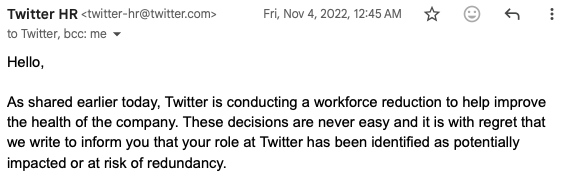
I remember looking at the #general channel on Twitter’s Slack instance the night I got laid off.
Messages poured in so quickly that Slack struggled to scroll quickly enough down through the
channel.
I left grad school with the thought that I’d return to academia after 5 years in industry, hoping that it would give me some extended time to work as a programmer in the wild and get a sense of the issues I’d encounter in reality. The 13 business days I spent at Twitter2 were enough to convince me that I’d paid my dues; I asked Gail—my former supervisor at UBC—if she’d consider taking me on as a PhD student. She said she would, but that I should also consider applying elsewhere. I ended up applying to UW, and somehow ended up convincing Mike to take me on as a student. I worked as a programmer for a local company in Vancouver, where I paid the bills and learned React in between getting laid off and starting my PhD in September 2023. There, I worked with another programmer who’d tell me about this website where you’d describe a program you wanted in plain English and you’d get back a program you could run.
Four Years In (2022–2026)
On November 30, 2022, OpenAI released ChatGPT. It reached 100 million monthly active users in January 2023, becoming the fastest-growing consumer application at the time. Anthropic released the first version of Claude on March 14, 2023, OpenAI released GPT-4 on the same day. Applications powered by LLMs flooded the world, ranging from conceivably useful tools like AI programming systems to breathtakingly useless flops like wearable AI companions. Open-weight models began to pop up and widened the loci of AI model development beyond wealthy frontier labs. People began to think about how LLMs could be more useful if they could perform some actions by themselves, to have agency beyond responding as a chatbot. Claude Code became generally available on May 22, 2025. Programming begins to change.
September 8, 2026. OpenAI publicizes a solution to the Navier-Stokes existence and smoothness problem, kicking off an authorship debate and a flurry of AI-authored solutions to long-standing problems in mathematics. On October 26 and 27, OpenAI and Anthropic independently announced disproofs of the Exponential Time Hypothesis (ETH).
November 20, 2026, two days after I started writing this blog post, a mathematician named Levent Alpöge announced a proof of the Riemann Hypothesis. The proof comprises 17 million lines of Lean written in collaboration with Claude. The Lean formalization was compiled and checked to be valid.
What Are We For?
Back in 2023, I tried ChatGPT on a whim when I was writing bash scripts for my first research project at UW. It didn’t get things right on the first try, and I was able to get what I wanted faster by patching together snippets I found on Stack Overflow. When we read papers about LLM-assisted programming and tooling in the software engineering reading group, we went from questioning whether LLMs were a passing research fad to seeing them overtake long-standing methods for some of our hardest problems. Last month, I used Claude to help launch experiments and write data-processing scripts for a paper I was revising. A day or two before the deadline, I needed a script to scan some code and report some metrics about functions and specifications. I wrote it myself.
I started by outlining the high-level structure of the code with function signatures, documented each function with its input and output, and finally worked on “filling in the blanks” (i.e., implemented each function). I hadn’t forgotten what I’d learned in lecture from Bill nearly a decade ago. When I was done, I looked at the clock and saw that about an hour and a half had passed. I felt melancholy. On one hand, I was happy and felt a sense of satisfaction knowing that I was still capable of programming, that I’d retained the ability to decompose a problem into a set of requirements and concerns that I could address with code. On the other hand, it felt quaint for me to spend an hour of my time on a task that a tool at my disposal could complete in minutes. Arguments about aesthetics aside, shouldn’t we use the best tools we have available? But happens if our tools become so powerful, so capable that our very place in our work shrinks and shrinks?
What are we for?
What Do We Do When Everything Is Done?
I’ve tied this question to my own work as a programmer and researcher in software engineering, but it’s a question that I’ve noticed many of my friends asking themselves in their own line of work. I find myself writing less and less code, and my friends who work as programmers barely write code, if at all. My colleagues who teach tell me that office hours are sparsely populated, and that students often prefer to “ask Claude or ChatGPT” when they have a question. Friends who work in theory are disheartened by how fundamental problems seem to fall each week to millions of lines of arcane proof.
What do we do when everything is done?
I think very few people truly believe that everything is done, but it’s tempting to think so when we look back at what’s happened in just the past year, or months. I don’t think I have an answer for teachers or theorists; I haven’t lived their lives. But for programmers, I find myself thinking back to what Bill said in lecture ten years ago. The goal of 110 wasn’t to teach a specific technology or language, it was to teach a way of thinking about the world that would be orthogonal to any tool.
Writing code is no longer the primary role of programmers. Maybe it never was. Recall the design recipe from 110. The entire point of it was to make us think about what a program should do, what its intended purpose should be. That is no less relevant today, If anything, they matter more now at the speed at which code can be written with AI. The role of programmers may now be to distill high-level requirements and design into intent that can be fulfilled by a tool.
But what is intent? Is it just the natural language in a prompt? Which parts? Do comments on a design document, or API documentation also express intent? Can we formalize intent in a formal grammar and make it machine-checkable?
The truth is, I’m sad that my job as a researcher and programmer doesn’t involve writing code as much as it used to. Until this year, I rarely went a day without writing code, or thinking about code. The speed at which programming has changed within the last few years has frightened me, and I’d be lying if I said otherwise. The speed at which the world has changed with AI, and what that means for our place in it, has made me deeply anxious. At the same time the bottleneck that was once implementation is gone, and I might be able to explore ideas that I would have shelved for lack of time. During a research meeting, my collaborators and I discussed a prototype tool that would enable programmers to write a program at different levels of abstraction: at the level of just function signatures, docstrings, or even input/output pairs. I was able to get a research prototype up-and-running overnight and demo it the next morning. This would have been at task that would have taken at least a week, if not more. I can launch experiments at a rate that would have been impossible for me to do alone. The speed at which I can explore new ideas has dramatically improved. Will this ultimately lead to people having better ideas? I am not sure, but I think it at least enables people to iterate on prototypes and evaluate ideas faster.
Maybe I’ll look back on what I wrote today in a few months and laugh at how far off the mark I was. But at least for now, we are not done. Not yet.
Acknowledgments
Thanks to Chandrakana Nandi and Michael Ernst for their comments on an earlier draft of this essay.